
Best Portable Power Stations UK (2026): 4 Current Picks
How this guide was made: this is a research-based roundup, not a hands-on lab review. Picks are based on manufacturer specifications, verified UK owner reviews, independent published test results, price history and what UK buyers are actually choosing. More on the method.
A power cut with a freezer full of food, a camping weekend with flat phones, or a campervan with no hook-up. A portable power station keeps small things running — but only if its capacity and output match what you actually need to plug in.
What size portable power station do I need?
Match capacity to your use: a few hundred watt-hours covers phones, laptops and lights on a camping trip, while roughly 1,000Wh upwards suits a fridge or router through a short power cut. Check the continuous output rating, not just capacity, for high-draw appliances.
Storm-season power cuts, home working, camping and garden jobs a long way from a socket all point at the same bit of kit: a lithium battery with mains sockets on the front. Prices have fallen, and the sensible mid-size units now cost less than a decent laptop.
This guide is research-led. Every capacity, output, solar input, charge time and cycle figure below is the manufacturer's published specification, restated here for comparison — MyGadgetDad has not independently measured any of them. What we bring is the sorting: which specification actually matters for which UK job, and where the marketing number and the real-world result diverge.
One thing to be clear about before anything else: none of these are whole-home backup. They power what you plug into them, not the house.
The Short Answer
Best compact communications backup: EcoFlow RIVER 3 Plus. Shoebox-sized and expandable — enough for router, phones, laptop and lamps through an evening outage.
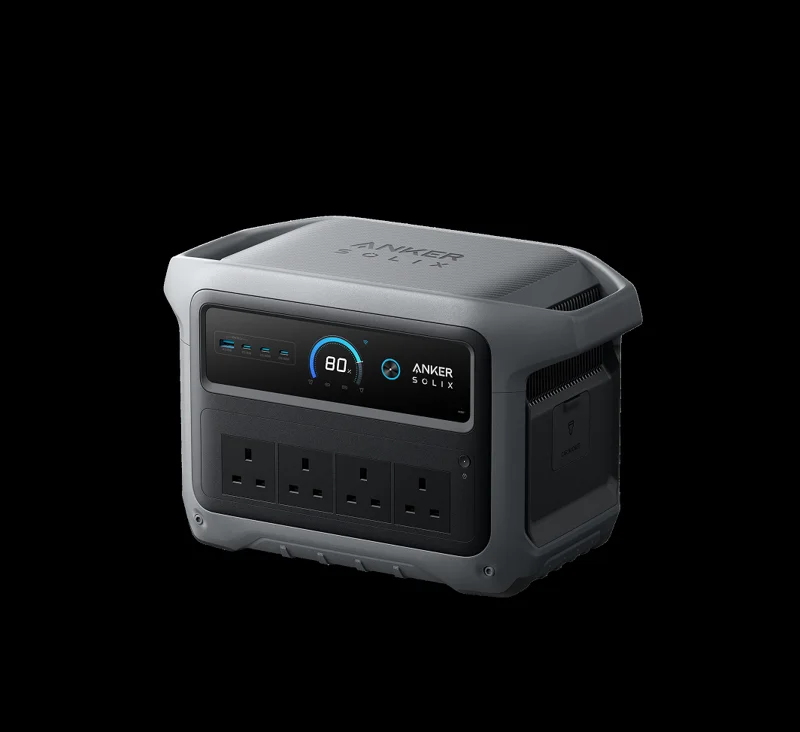
Best all-round 1kWh-class option: Anker SOLIX C1000 Gen 2. Just over a kilowatt-hour with a large inverter, the sensible one-unit-covers-most-things choice.
Best for camping and caravan use: Jackery Explorer 1000 v2. Light for its capacity, simple to operate without an app, and easy to pair with folding panels.
Best high-capacity option: BLUETTI Elite 200 V2. Around two kilowatt-hours and a large inverter, for a full day rather than an evening.
Watt-Hours Versus Watts: The Number People Get Wrong
A power station is a battery, an inverter and a set of sockets. The battery is rated in watt-hours (Wh) — how much energy is stored. The inverter is rated in watts (W) — how much can be drawn at any one moment.
People buy on the first number and get caught by the second. A station may not run a fridge or any motor load if its continuous or surge rating sits below the appliance's start-up demand, however much energy is stored inside it. Anything with a motor or a heating element needs surge headroom above its running draw, which is why manufacturers quote a separate surge rating — check the manufacturer's manual and the appliance's own rating label before assuming a pairing works.
As a working guide for a UK home: a broadband router draws 10-15W, a laptop 45-65W, an LED lamp 6-9W, a fridge-freezer 100-150W while the compressor runs, and a 55-inch TV about 100W. That is why a 1kWh-class station can usually keep a household connected, fed and lit for the length of most outages, while a 3kW kettle sits above the continuous rating of everything here.
Comparison: Which One Fits Your Use
At a glance: how the picks compare
Typical UK prices and published specs at the time of writing — always check the live price.
| Product | Best for | Capacity (manufacturer) | Inverter (manufacturer) | Price | Retailer link |
|---|---|---|---|---|---|
| Best compact communications backupEcoFlow RIVER 3 Plus | Choose it if the job is router, phones, laptop and lamps through an evening cut. | 286Wh LiFePO4 | 600W | Check current price | Check PriceAffiliate · Amazon UK |
| Best all-round 1kWh classAnker SOLIX C1000 Gen 2 | Choose it if you want one battery for outages, the garden and occasional high-draw kit. | 1,024Wh LiFePO4 | 2,000W (3,000W peak) | Check current price | Check PriceAffiliate · Amazon UK |
| Best for camping and caravansJackery Explorer 1000 v2 | Choose it if the unit travels — light for its class, with a simple panel ecosystem. | 1,070Wh LiFePO4 | 1,500W | Check current price | Check PriceAffiliate · Amazon UK |
| Best high capacityBLUETTI Elite 200 V2 | Choose it if you need a full day of fridge, comms and tools rather than an evening. | 2,073Wh LiFePO4 | 2,600W | Check current price | Check PriceAffiliate · Amazon UK |
Best compact communications backup
EcoFlow RIVER 3 Plus
Choose it if the job is router, phones, laptop and lamps through an evening cut.
- Capacity (manufacturer)
- 286Wh LiFePO4
- Inverter (manufacturer)
- 600W
- Price
- Check current price
Check PriceAffiliate · Amazon UKBest all-round 1kWh class
Anker SOLIX C1000 Gen 2
Choose it if you want one battery for outages, the garden and occasional high-draw kit.
- Capacity (manufacturer)
- 1,024Wh LiFePO4
- Inverter (manufacturer)
- 2,000W (3,000W peak)
- Price
- Check current price
Check PriceAffiliate · Amazon UKBest for camping and caravans
Jackery Explorer 1000 v2
Choose it if the unit travels — light for its class, with a simple panel ecosystem.
- Capacity (manufacturer)
- 1,070Wh LiFePO4
- Inverter (manufacturer)
- 1,500W
- Price
- Check current price
Check PriceAffiliate · Amazon UKBest high capacity
BLUETTI Elite 200 V2
Choose it if you need a full day of fridge, comms and tools rather than an evening.
- Capacity (manufacturer)
- 2,073Wh LiFePO4
- Inverter (manufacturer)
- 2,600W
- Price
- Check current price
Check PriceAffiliate · Amazon UK
*Prices move constantly, so we no longer quote fixed figures — follow the retailer link for the current price. Capacities and inverter ratings are manufacturer specifications, not MyGadgetDad measurements. Solar panels are sold separately in almost every case.*
Get Your Free UK Home Energy Audit Checklist
Cut your energy bills with our UK home energy audit checklist, plus our best gadget deals — free.
1. EcoFlow RIVER 3 Plus — Best Compact Communications Backup
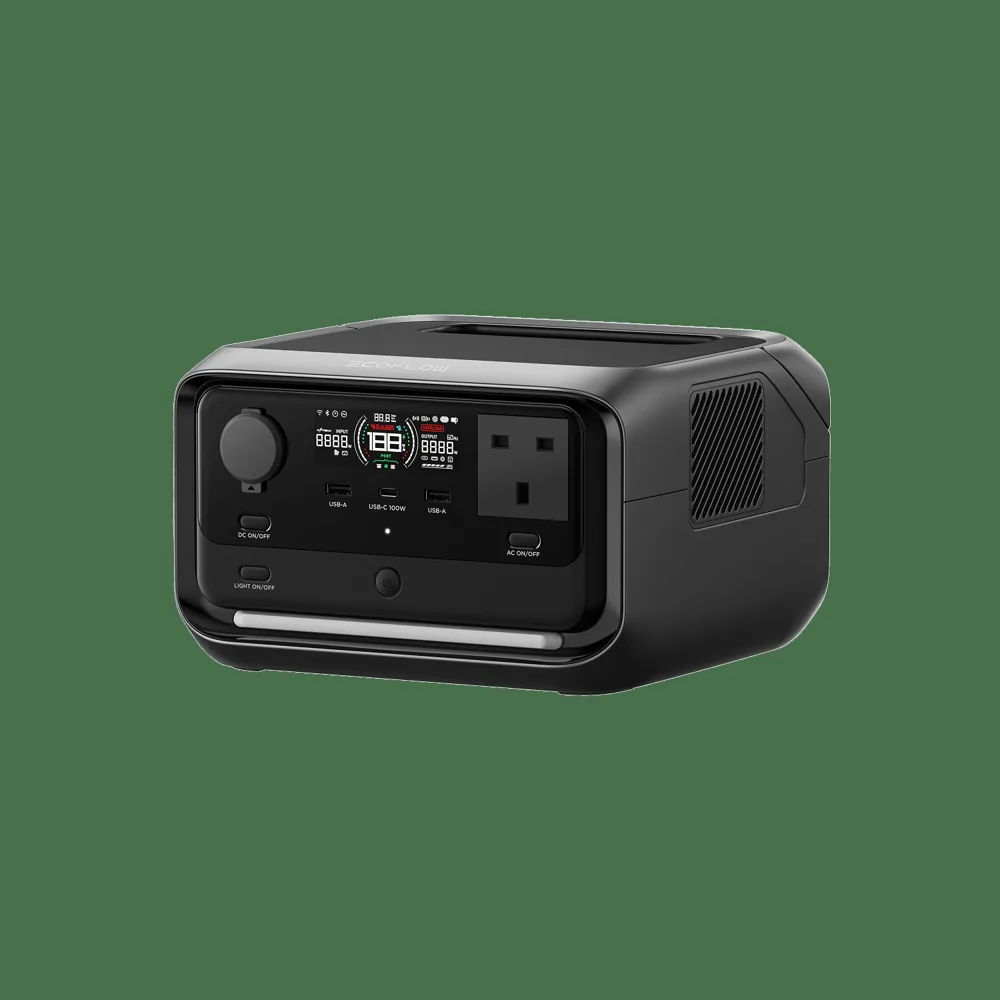
Most households do not need a kilowatt-hour. EcoFlow rates the RIVER 3 Plus at 286Wh of LiFePO4 with a 600W inverter, in a unit around the size of a shoebox and under 5kg — which on those figures covers a router, a laptop, phones and lamps for an evening, and that is the overwhelming majority of UK outages.
The useful design decision is the clip-on extra battery: start small and roughly double capacity later if it turns out you need it. EcoFlow also publishes a fast mains recharge, so a top-up between weather warnings is realistic.
Choose it if: your outage plan is comms, lighting and devices; you want something light enough to move around the house; you would rather buy small now and expand later.
Do not choose it if: you want to run a fridge, a heater or power tools — at a 600W continuous rating those loads are unlikely to start or sustain, and extra battery capacity does not change an inverter limit. Check the appliance label against the station's continuous and surge ratings.
2. Anker SOLIX C1000 Gen 2 — Best All-Round 1kWh-Class Option
Anker's current UK product page rates the C1000 Gen 2 at 1,024Wh of LiFePO4 with a 2,000W inverter and 3,000W peak output intended for compressor and power-tool start-up, plus a published mains recharge measured in tens of minutes rather than hours. On paper that is the combination that covers the widest set of UK jobs from a single box.
It is the unit to buy if you do not want to think about it twice: fridge and freezer through an outage, a circular saw at the bottom of the garden, and the app reporting live draw so you can see what each appliance costs while it runs.
Choose it if: you want one battery for power cuts, garden work and occasional high-draw kit; you value fast mains recharge over portability.
Do not choose it if: you will be carrying it any real distance — it is a car-boot-and-garden unit, not a rucksack one — or if your needs genuinely stop at comms and lighting, where the RIVER 3 Plus saves you a few hundred pounds.
3. Jackery Explorer 1000 v2 — Best for Camping and Caravan Use
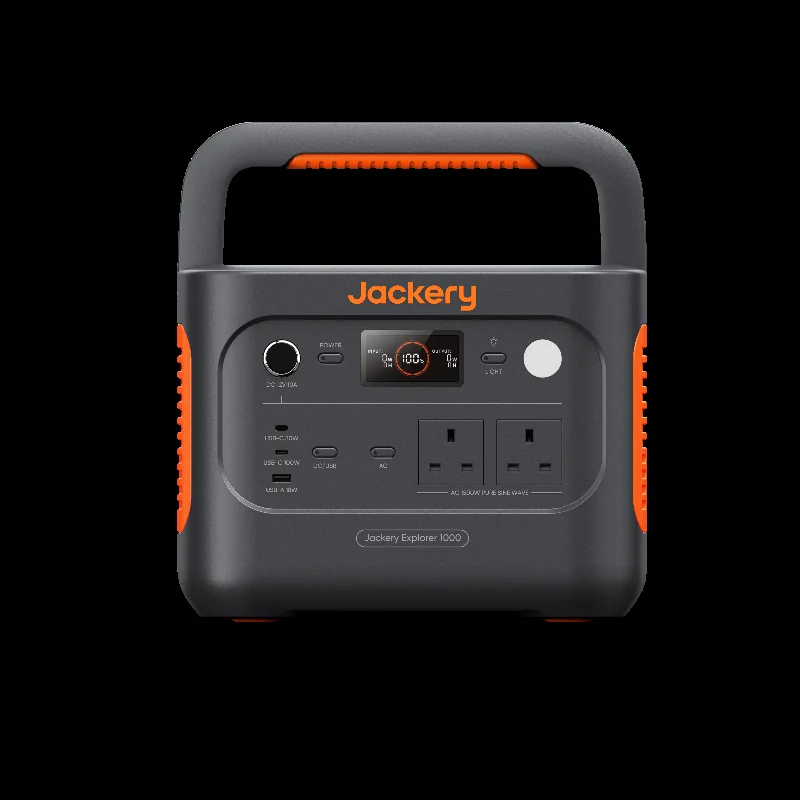
Jackery made this category mainstream, and the v2 revision moves the Explorer 1000 to LiFePO4 cells with a manufacturer-quoted 1,070Wh capacity and a 1,500W inverter, in a body Jackery lists as noticeably lighter than the 1kWh competition.
For away-from-the-house use — lights, a cool box, camera batteries, a laptop in the awning when it rains — that weight difference is the whole argument. The solid handle, no-app operation and the widely stocked folding panel range make it the easiest of the four to live with on a campsite or in a caravan.
Choose it if: the unit will travel regularly; you want a straightforward display rather than an app; you plan to buy matching solar panels without researching connectors.
Do not choose it if: it will live plugged in at home as backup — the Anker's larger inverter and faster mains recharge suit that role better for similar money.
4. BLUETTI Elite 200 V2 — Best High-Capacity Option
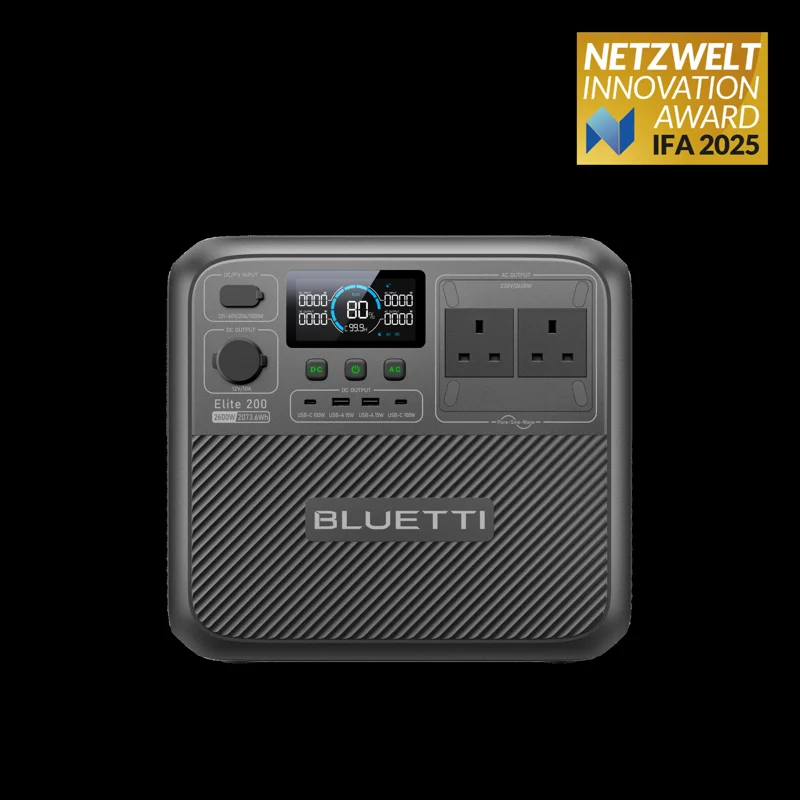
BLUETTI specifies the Elite 200 V2 at 2,073Wh of LiFePO4 with a 2,600W inverter, which is roughly double the storage of the 1kWh class and enough headroom for most single household appliances short of a full-size kettle.
The case for it is duration rather than power alone. If your concern is a long rural outage, a work-from-home setup that cannot go dark, or a caravan away for several days, the extra kilowatt-hour is the difference between rationing and simply carrying on. Expect it to be the heaviest here.
Choose it if: you need a full day rather than an evening; you want to run a fridge plus office kit plus lighting simultaneously; you have somewhere permanent to keep it.
Do not choose it if: budget or weight is the deciding factor, or your realistic outage is three hours long — you would be paying twice over for capacity you never reach.
Sizing: How Many Watt-Hours Do You Need?
Work it out rather than guessing. Watts × hours = watt-hours, then add about 15% for inverter losses.
Stay-connected kit (router, two phones, a laptop, two lamps) for six hours: roughly 250Wh — the RIVER 3 Plus.
The above plus a fridge-freezer overnight: roughly 800-1,000Wh — the SOLIX C1000 Gen 2.
A weekend camping with a cool box: 600-1,000Wh, plus a panel if the forecast is kind — the Explorer 1000 v2.
A full day of household essentials, or several days in a caravan: 1,500-2,000Wh — the Elite 200 V2.
Power tools in the garden: capacity matters less than the inverter — you want 1,500W continuous or more.
If you already own a metering smart plug, use it: run the appliance for an hour and read the actual figure rather than trusting the label. Our smart plugs guide covers the metering models that do this.
Charging From Solar in the UK
Portable panels work here, but British light is the limiting factor and manufacturer solar input ratings describe the port's maximum, not what a panel will deliver in Manchester in November.
A 200W folding panel commonly returns well below its rated output even in good summer conditions, and midwinter yield can fall to a fraction of that. Treat solar as genuinely useful for camping and allotment top-ups, and marginal for winter backup — in a December outage what matters is that the battery was already full from the mains. If you are weighing rooftop generation instead of folding panels, the solar and outdoor power guide has the UK payback maths.
Five Checks Before You Buy

1. Check the inverter, not just the capacity. Find the highest-wattage thing you intend to plug in, then confirm both the continuous and surge ratings clear it.
2. Check the cell chemistry and cycle rating. For a unit that lives charged as backup, LiFePO4 and a published cycle figure in the thousands are what you are paying for.
3. Check the recharge route you will actually use. Fast mains recharge matters far more than solar input for UK home backup.
4. Check the sockets against your kit. Count UK three-pin outlets, USB-C wattage and any 12V output you need for a cool box, rather than assuming.
5. Check weight and where it will live. A 1kWh unit is typically low-to-mid teens in kilos and a 2kWh unit heavier again; if it has to go up stairs or into a tent, that decides the shortlist.
Safety, Batteries and What to Avoid
Buy LiFePO4 if the unit will sit charged as backup: manufacturers rate the chemistry for several times the cycle life of older lithium-ion, with better heat tolerance.
Avoid no-name units with implausible specifications — a suspiciously cheap listing claiming 1,000Wh and 2,000W is misrepresenting one number or both. Look for a named brand, a UK three-pin plug, a published cycle rating and a warranty that can be claimed in the UK.
Never run a power station inside a sealed cupboard while charging at full speed, keep it off carpet so the vents stay clear, do not use one in an enclosed space with damaged cells, and top it up every few months if it is in storage. Again: these are appliance-level backup, not a house supply.
The Verdict
Buying GuideFor most UK households the Anker SOLIX C1000 Gen 2 is the one to buy — the 1kWh class covers outages, the garden and high-draw kit from a single box, with the fastest published mains recharge here.
Take the EcoFlow RIVER 3 Plus if your plan stops at comms and lighting, the Jackery Explorer 1000 v2 if the unit travels, and the BLUETTI Elite 200 V2 if you need a full day rather than an evening.
Once the battery is in the house, a home energy monitor tells you what everything actually draws — which makes sizing the next one straightforward.
*We do not quote fixed prices here — check the retailer link for the current figure. This article contains affiliate links — see our disclosure. Capacities, inverter ratings, solar input, charge times and cycle life are manufacturer specifications restated for comparison, not hands-on test results. Whether a given appliance will start and run depends on its own start-up demand — check the manufacturer manual and the appliance rating label. These units are not whole-home backup.*
Frequently Asked Questions
Keep reading
Solar & Outdoor Power UK [2026]
Panels, batteries and portable power stations with real UK payback maths.
Read the guideBest Home Energy Monitors UK [2026]
See which circuits actually cost you money before you buy anything.
Read the guideBest Smart Plugs UK [2026]
Metering plugs that expose standby drain and real running costs.
Read the guide